
Why Two Markets Usually Means Zero
“Serving both civilian and defense markets” has become one of the most attractive narratives in deep tech.
It promises:
- Faster commercialization through civilian markets
- Asymmetric upside through defense adoption
For founders, it signals flexibility. For investors, it signals optionality.
But beneath the surface, dual-use is often not a strategy – it is a misinterpretation of how markets, institutions, and power structures actually function.
The critical mistake is simple:
- In practice, the opposite is usually true.
- Assuming that if a technology can exist in two domains,
- a company can operate in both.
“ Technology can be dual-use. The organizations built to commercialize it almost never are.
— UAX Investment Team
1. Two Markets, Two Operating Logics
Civilian and defense markets do not differ only in customers.
They differ in how they operate at a system level.
Commercial markets: optimize for speed, cost, and user experience; reward iteration and distribution leverage.
Defense systems: optimize for reliability, survivability, and control; operate through doctrine, hierarchy, and long-term planning.
Institutions like the U.S. Department of Defense are not “buyers” in a traditional sense. They are systems of capability building, where acquisition is only one component of a much larger structure.
Civilian vs. Defense Operating Logic
| Dimension | Commercial Markets | Defense Systems |
|---|---|---|
| Core optimization | Speed, cost, user adoption | Reliability, survivability, control |
| Market access | Capture distribution nodes | Navigate institutional access |
| Validation standard | Functional performance | Adversarial, real-world conditions |
| Deployment model | Rapid iteration and rollout | Multi-stage integration |
| Risk tolerance | Acceptable failure | Near-zero tolerance for failure |
| Decision driver | User adoption metrics | Operational doctrine alignment |
2. Go-To-Market Is About Power, Not Sales
The common framing of go-to-market as funnels, pipelines, or sales execution is insufficient.
In reality, GTM is about who controls access to distribution. In commercial markets, distribution can often be captured or leveraged. A single partnership with a dominant player such as Amazon or Walmart can unlock massive scale.
In defense, there is no equivalent node. Access is mediated through procurement systems, institutional relationships, and program alignment. Initiatives like DIU and AFWERX attempt to accelerate access, but even they operate within constrained pathways. In commercial markets, distribution is something you can win. In defense, distribution is something you must be allowed into.
3. Validation Is Not Transferable
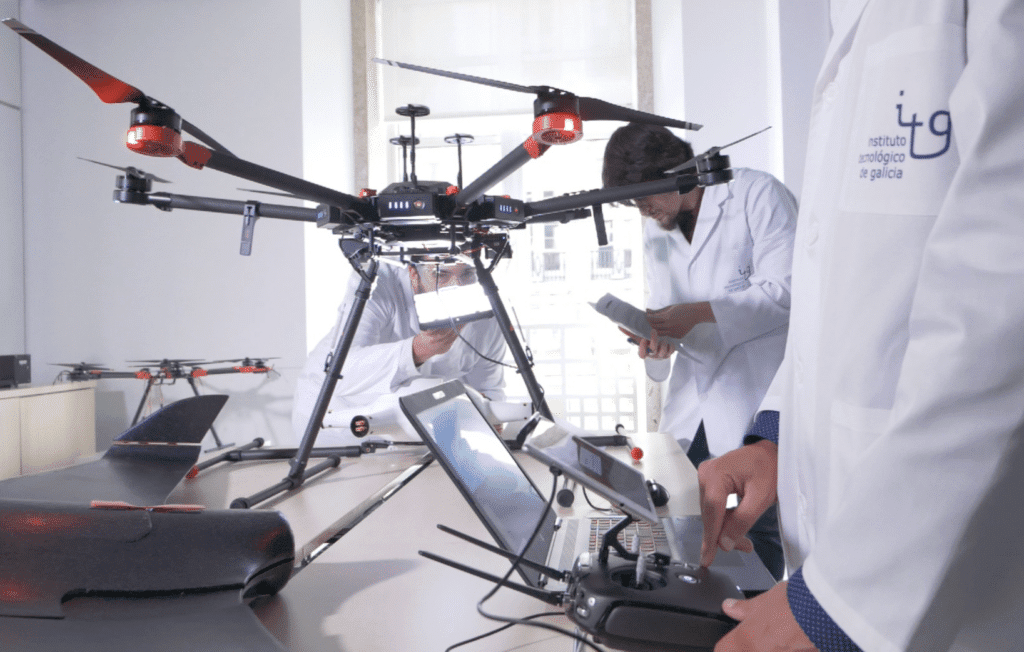
One of the most persistent myths in dual-use is that validation carries across domains. It does not.
Civilian validation proves functionality and usability. Defense validation requires performance under adversarial conditions (jamming, spoofing, degradation) and integration with operational systems.
Case Study: DJI and the Limits of Commercial Validation
DJI dominates the global commercial drone market. Its systems are widely adopted and highly reliable in civilian environments. Yet, U.S. and allied defense systems have restricted their use. As detailed in the latest 2026 Pentagon update on drone security, concerns around data security and supply chain exposure have shifted the debate from technical polish to national security red lines. A system fully validated in civilian markets can still be non-viable in defense because it fails contextually.
4. Integration Is the Real Barrier to Deployment
In modern systems, standalone performance is not enough. Deployment depends on integration into existing architectures: sensors, communication layers, and command and control systems. Standards such as STANAG 4586 define how systems must operate within allied frameworks. A product that cannot integrate cannot be trusted, scaled, or deployed.
5. Procurement Is a System, Not a Transaction
From the outside, defense acquisition appears slow. From the inside, it is functioning as intended to manage risk, ensure accountability, and align with long-term strategic objectives. Official reports from the U.S. Government Accountability Office (GAO) describe the difficulty of transitioning technologies from pilot programs into full deployment, a systemic gap known as the “valley of death.” In our Due Diligence process at UAX, we see the gap between lab prototypes and the field is enormous.
6. Economics Break Under Dual Optimization
Dual-use is often framed as diversification. In reality, it introduces duplicated requirements, conflicting priorities, and fragmented execution. Capital is not leveraged; it is diluted. The result: a company that is too slow for commercial markets and too misaligned for defense.
7. Power Structures Define Outcome
Markets are not neutral. They are shaped by control. Commercial ecosystems are platform-driven and distribution-led. Defense ecosystems are institution-driven and access-controlled. As noted in recent analysis from the Center for Strategic and International Studies (CSIS), innovation outcomes depend as much on “technology maneuver” and institutional alignment as they do on technical capability.
Dual-use is not a feature. It is a constraint. Technology can be dual-use. Companies rarely are.At UAX, the focus is not on theoretical applicability. It is on real-world validation, integration, and deployment. Because what matters is not where a technology could work, but where it actually will.