
What operators see in 10 minutes that analysts miss in 10 weeks.
If you’re a tier-one investor coming from SaaS, AI, or cyber, you already know how to run a strong due diligence process. You know how to evaluate founders, understand markets, read numbers, and assess product potential.
That foundation still holds in defense.
But defense adds a layer of software never required: the technology has to work not just in a demo but in real conditions, under stress, in environments that are unpredictable and unforgiving.
In defense, you’re not investing in a product. You’re investing in whether it works when it matters.
Getting that part right is what turns a good investment into a confident one.
The odds are already against you. Defense makes that gap visible earlier and more expensive to ignore.
Venture outcomes follow a power law. Very few investments carry the returns.
Even before getting into defense, venture outcomes are already unforgiving.
of VC-backed startups ever reach $100M+ in revenue. Most don’t scale, that’s not pessimism, it’s the baseline.
The investors who consistently outperform are not relying on access or speed.
They operate with sharper evaluation frameworks and apply them with discipline.
In defense, that discipline has a clear focus: technical diligence.
And the gap between doing it well and doing it superficially is wider here than anywhere else.
Going deeper without slowing down
The challenge isn’t whether to go deeper.
It’s how to do it without slowing the process or losing deal access.
The investors who get this right are not adding friction.
They are running a different type of evaluation.In defense, diligence is no longer just about what you check.
It’s about how the validation is done and who is doing it.
Who is Validating and How the Field Test Happens
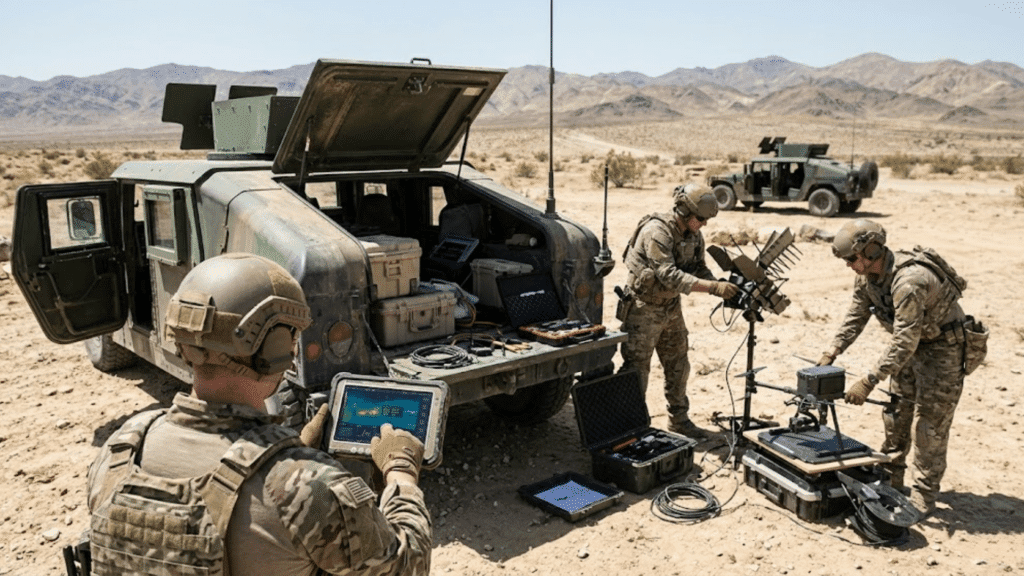
Technical evaluation in defense cannot rely on desk reviews or spec sheets.
It requires people who understand how systems behave in real environments: operators, engineers, and domain experts with actual field experience.
And it requires seeing the system in action. Not a curated demo or a structured field test.
A field test answers what matters:
These are not edge cases. These are the conditions the system is built for, and the same questions a procurement committee will ask.
How to Structure It
A practical way to structure technical validation is through six core blocks commonly applied in systems such as unmanned platforms and drone technologies:
Deployment & Setup
Can a real team get it operational, or does it depend on ideal conditions?
Detection & Tracking
How consistent is performance across real environments?
Operator Workflow
Can decisions be made quickly and clearly under pressure?
Response Capability
Does the system move effectively from detection to action?
Reliability & Serviceability
Is this ready to operate at scale, or still early beneath the surface?
Alignment
Do both sides leave with the same understanding of what works and what still needs validation?
This is not about adding complexity.
It’s about creating clarity – quickly.
This is the approach we use at UAX.
Why this directly impacts procurement
In defense, procurement is where everything gets tested for real.
Independent reviews of U.S. defense acquisition consistently show challenges in delivering systems on cost, schedule, and performance (Source: U.S. Government Accountability Office).
The strongest early signal of procurement success comes from technical diligence done properly, because procurement is not driven by interest, but by thresholds: interoperability, reliability, usability, and performance under real conditions.
A system that proves itself in structured field validation is not just a strong product.
It’s a credible procurement candidate.
And it gives you something rare as an investor: a grounded view on timeline.
Not optimistic. Not conservative. Accurate.
The Real Advantage
Very few investments drive returns.
In defense, where cycles are longer and procurement gates are real, the gap between assumption and outcome shows up earlier and costs more.The investors who consistently win are not doing more diligence.
They are doing the right kind with the right people, in the right conditions, asking the questions that determine whether a company can convert:
Technology → Procurement → Scale
In defense, the winner wins bigger.
Technical diligence is not another step in the process. It’s the diamond at the center of it.